Home My Classroom My Products Freebies Instagram TeachersPayTeachers Bloglovin Pinterest Email Image Map

7.03.2015

Organizing Task Cards

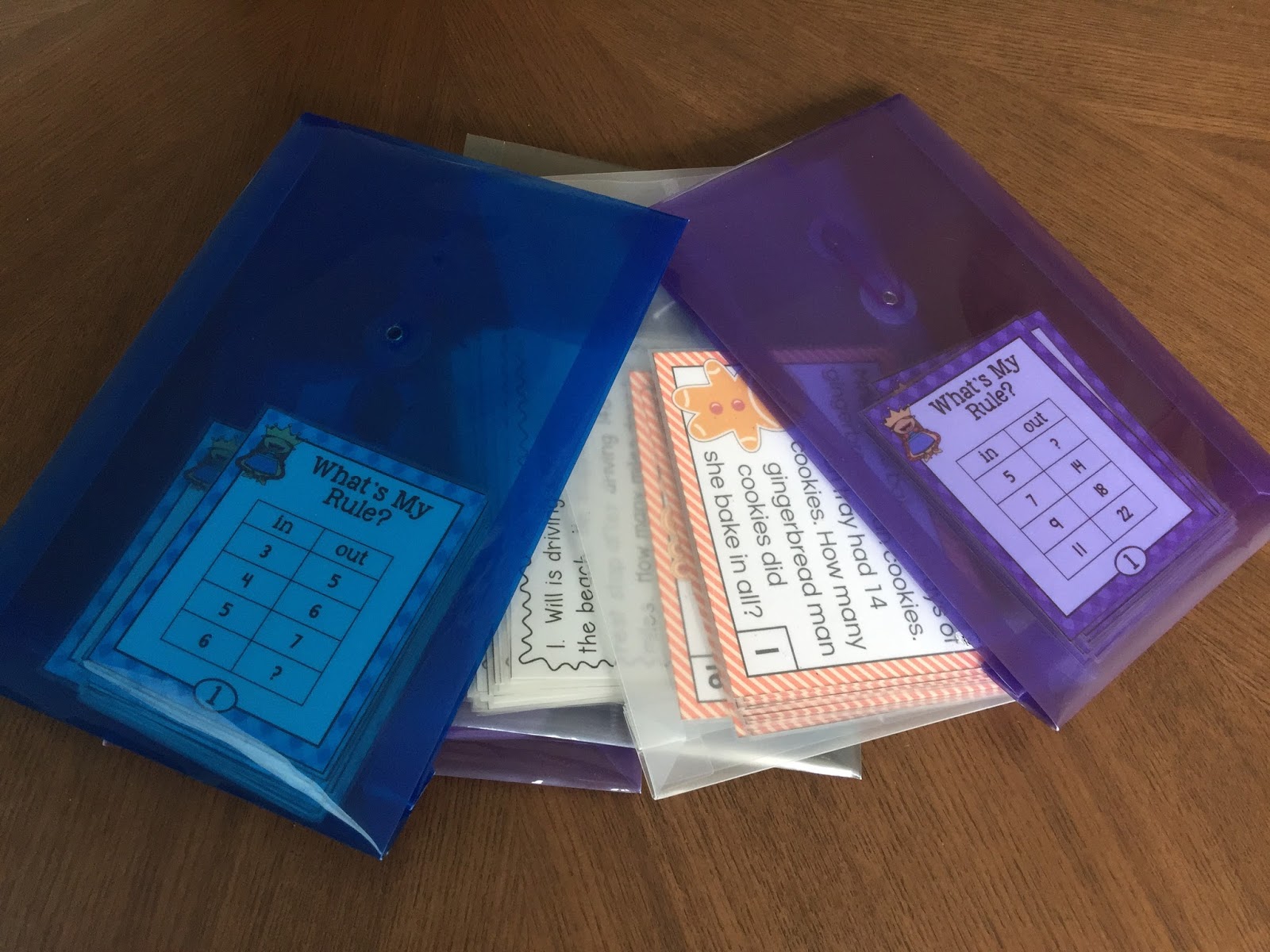
I use a lot of task cards in my classroom and I've tried many ways to organize them. I found that manila envelopes are cheap but get ruined very quickly. Rubber bands keep them together but aren't something I want the kids to have and they never get put back correctly. Last year I found several plastic organizer boxes that were the right size. I got index card dividers to put between them...


Not bad, right? It worked fairly well but I still had a few problems. One was flipping through the box to find the set I wanted. Even more importantly, I still didn't have anything to keep the cards in when in use, like at centers. 

So I've been on the lookout for something better and I think I may have hit the jackpot...


I found these thick poly-something envelopes on Amazon. They are the perfect size and are gusseted so they expand if you have a really large set of cards. I really love how they are transparent enough to see what's inside. They also have a string closure - the kind where you wind the string around a little round doo-hicky - so they won't be falling out all over the place. 


They are kind of pricy (6 assorted colors for $7.98) but plastic poly stuff that they're made of is nice and sturdy. They should stand up to a lot of use and abuse. I think I'll use my handy-dandy label maker and put a label in the top corner of each one. That way I can stand them up in a basket and be able to quickly find the set I need. I think these will work out nicely! 

How do you store and organize your task cards? Leave a comment and let me know!


6.15.2015

Makeover Madness: TpT Seller Challenge Week 1

Now that school is out, I have quickly and easily slipped into sit-on-my-butt mode. I need motivation and luckily I discovered the TpT Seller Challenge. At least that will get me working on SOMETHING.

The challenge for this week is called Makeover Madness. I was supposed to pick one of my products that needed a makeover and well, make it over. I actually had quite a few to choose from, (Boy, did some of those early creations look bad!), so this was the perfect challenge for me. I decided to re-do my Hoppin' Good Behavior Clip Chart. It was a cute idea, I think, but the combination of fonts, colors, and backgrounds I used was terrible and the cover was hideous. Here's how it looked before...
Ugly, right? It wasn't just the cover. The whole thing was bad, except for the frogs. They were cute at least. So I kept the frogs, added a fly, changed the backgrounds and fonts, and added a weekly behavior report. Here's the makeover...

5.04.2015

Engaging Kids in Informational Writing

The end of the school year is such a busy time, isn't it? I know most of you probably feel like me... worn out by testing and ready for summer but still looking at a to-do list a mile long!  Add to that student behavior that is, well, less than stellar. Ugh!

I've been finding reading centers to be particularly hard lately. These third graders have nothing on their minds except socializing and acting like the fourth graders they haven't quite become yet. So I took the drastic measure of canceling reading centers. That's right... I canceled them. No more centers! 

So, what are these children doing for an hour every day? Research and writing. Wow, that sound boring... zzzzz. But check out some of their finished work and you tell me, does this look boring?

expository writing


These are the students' self-published "Time For Kids" magazines. After using TFK in our guided reading groups for awhile, I decided to use them as a way to get the kids writing.

First, we brainstormed ideas for topics and created a "topic menu". They came up with things like the San Francisco earthquake, the Titanic, Pompeii, the New York Yankees, Martin Luther King Jr., and the Apollo Space Mission. They were all VERY excited to contribute to the menu.

Then we closely analyzed TFK to figure out what makes them so interesting. The kids noticed that the paragraphs were short with text features to go with them. They noted that there were a lot of very interesting facts and that each section had its own heading. They pointed out the colorful illustrations and interactive features like links to videos. We decided it would be a good idea to use index cards for each paragraph or sub-topic.

Next, we talked about how to conduct research including how to paraphrase, how to cite your source (which we've been working on for awhile), and how to take notes. I also made a list of acceptable websites that they could access on the computer or ipads.

Finally, they were ready to go and boy, did they dive right in! Most of them chose to partner up for their first topic. They spent several days researching with some of them asking to visit the media center to find even more information. During reading groups, I looked over what they had done so far and offered guidance as needed. Some things they had trouble with at first were writing good headings for each paragraph and forgetting topic sentences.

After our first round of TFK publishing, the kids decided they wanted to do more, so they all chose a new topic! Some decided to work on their own because they were excited to research something specific. It was great seeing them so absorbed in their writing. Most of them spent a full week doing research and another week writing, illustrating, and editing. Their hard work really paid off! Take a look at some of these finished pieces...


Now that the school year is coming to an end, I wish we had more time for projects like these. But hey, I'm still ready for summer to start!

Don't forget to check out TpT's big Teacher Appreciation Sale starting tonight at midnight!


2.21.2015

You Oughta Know About Winning The Pencil War


When I was a kid, I loved school supplies. I mean really LOVED them. Crisp white sheets of paper, bright markers, a brand new pink eraser, binders, notebooks, index cards. What could be better? It's secretly why I became a teacher. (You too? We should start a club!)

I still love school supplies. Well, most of them. I seem to have developed a love/hate relationship with the King of all school supplies. That's right... the Number 2 Pencil. My classroom is perpetually littered with them. It's not just yellow number 2s that I hate... blue ones, plain wood ones, and especially the ones with pictures all over them that peel off and clog up your pencil sharpener. I hate that my students regularly stick in a nub and sharpen it until it's jammed inside of the machine. Most of all, I hate that they spread their pencil love all over my classroom floor on a daily basis...


So what's a teacher to do? There's actually a solution. Something I used a few years ago when I had the worst class on Earth (the ones who purposefully stuffed things down the toilet to make it overflow on a daily basis). I don't know why I forgot about this. Maybe because I've had such lovely students since then. But the pencils are starting to make me crazy, so it might be time to pull out the big guns...


So what is this little miracle? A wonderful teacher named Mrs. Hazelton created a FREE resource called "Winning The Pencil War" to help us all stay on top of the pencil problem. Here's the gist...
  • Give each kid their own pencil pouch with 8 sharpened pencils.
  • They keep track of their pencils all week.
  • Collect the pouches on Friday.
  • Reward the ones who kept all 8 pencils in good condition.
There's a bit more to it than that, but not much. It's very simple to implement and she includes complete instructions and the little coupons you'll be using. If you're smart, you'll assign a student to collect the pouches on Friday and pass them out again Monday morning. I found that having two baskets made it even easier. Students who knew they didn't keep all 8 pencils put their pouches into one basket. The ones who thought they did a good job put theirs in the other basket. Checking them was a breeze! As an extra motivation, I occasionally left a little treat in the good bags.

Once I started using this system, my pencil woes were over. It really worked! Like I said, my classes since then have been quite lovely and I haven't had much of a pencil war going on. But with spring fever setting in and my room looking like the pictures above on a pretty regular basis, this might be the perfect time to pull out my pencil pouches once more.

(Here's a little tip: If pencil bags aren't in your budget right now, quart size freezer bags work quite well.)

So now that you know about this little sanity-saver, what about your pencil sharpener? Does it sound like a dentist's drill gone awry? Do your pencils come out looking like they were gnawed by a beaver? Then you will want to know about the The Quietest Classroom Sharpener. It's super fast and sharpens better than any electric sharpener I've ever seen. It even takes care of those cheap-o pencils from China with the lead that just falls out all the time. Take a look...


Looks pretty good, huh? You can buy one from Classroom Friendly Supplies or you can win your own super awesome sharpener right here:


Good luck! Now head on over to the blog hop to see what else "you oughta know about"!

2.06.2015

KEY WORDS... A Bad Math Strategy: Part I

I remember back in college taking a course called Mathematics For Elementary School. One of our group assignments was to create posters (now called anchor charts) of problem solving strategies. I don't recall what my group came up with but at least half of the class made posters showing "key words" for solving word problems. Apparently this was A-ok with our professor because they were hung all around the room. You know the kind of posters I'm talking about. 


Teachers still have charts like this and still teach kids to use key words. I'm here to tell you to stop it, stop it right now! Okay, that was a little harsh but really, don't do it. Here's why... When you teach kids to look for key words, you're teaching them not to think. Looking for key words is way a to opt-out of thinking through the problem. Children who have been taught the key word strategy don't study a problem. They don't think about what it means or what is happening or how they could figure it out in real life. Instead, they scan through the problem, searching for those all-important key words, until they strike gold. Then they use whatever operation "goes with" that key word... even if it doesn't make sense. 

Don't believe me? Let's test out some of the magical key words...

IN ALL: This means you should add, right?
  • Mary had 12 candies. She bought 7 more. How many did she have in all? Easy! 12+7=19 candies. Maybe it does work...
  • How about this one... John bought 7 cartons of eggs. Each carton contains 12 eggs. How many eggs did he buy in all? Umm, 7+12=19 eggs?
  • 75 people visited the museum on Sunday. Twice as many visited on Saturday. How many people visited the museum in all? Oh no, what do I add? There's only one number!

HOW MANY MORE? Time to subtract!
  • The third grade is going on a field trip. 44 students fit on the first bus. How many more buses are needed for the other 70 students? Hmm... 70-44=26 buses. That seems like an awful lot of buses!
  • Sam went to a movie that started at 2:45 and ends at 4:10. It is now 3:30. How many more minutes are left before the movie is over? Uhhhhh....

These are just a few examples of why key words just don't work. It gets even messier when students are asked to explain their thinking or to draw a model, as they so often are on today's assessments. Not only do they get the wrong answer, but the only explanation they can come up with is, "Because the problem said 'in all' and that means you add."

So what's a kid to do when faced with the dreaded word problem? I'll talk about that in Key Words: Part II. Stay tuned...
Related Posts Plugin for WordPress, Blogger...